
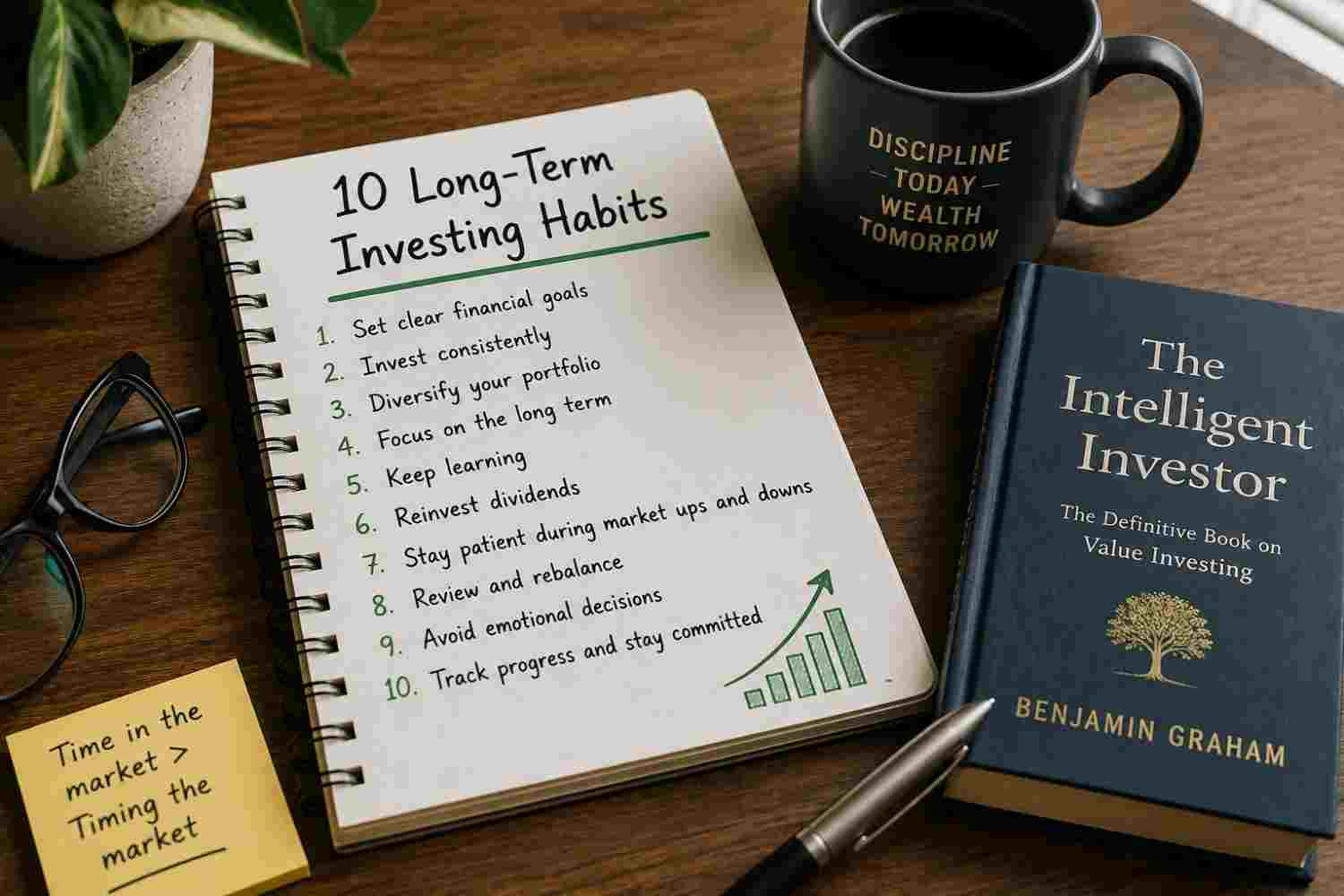
Most people don’t lose money in the stock market because they picked the wrong stock. They lose money — or miss out on growth — because of what they do with their money over time. The habits, not the hot tips, are what separate investors who build real wealth from those who stay stuck.
The good news? None of these habits require a finance degree, a lucky guess, or a big paycheck to start. They just require consistency. Here are 10 long-term investing habits that can quietly reshape your financial future.
1. Start Before You Feel “Ready”
Waiting for the perfect moment — more savings, less debt, a market dip — is one of the most common ways people delay building wealth for years.
Time in the market matters more than timing the market. Someone who invests $200 a month starting at age 25 will likely end up with more money by retirement than someone who invests $400 a month starting at 35, Investing even though the second person put in more total cash. That’s the power of compound growth working quietly in the background for an extra decade.
What this looks like in practice:
- Open an investment account even if you can only fund it with $50
- Automate a small monthly contribution instead of waiting to “have extra”
- Treat investing like a bill you pay yourself, not an optional extra
2. Automate Your Contributions
Willpower is unreliable. Automation isn’t.
When you set up automatic transfers into an investment account, you remove the monthly decision of “should I invest this month?” This is the same principle behind 401(k) payroll deductions — money that never touches your checking account is money you never miss.
A useful trick is to increase your automatic contribution slightly every time you get a raise, Investing before your spending catches up to your new income. If you get a 3% raise, redirect half of it into investments and let the rest boost your lifestyle.
3. Diversify — But Don’t Overcomplicate It
Diversification means not putting all your money into one stock, one sector, or one country. It’s not about owning 40 different funds; it’s about making sure one bad outcome doesn’t wipe you out.
A simple, well-diversified portfolio might include:
- A broad domestic stock index fund
- An international stock index fund
- A bond fund for stability
- Cash or a money market fund for near-term needs
Investors who held only tech stocks during the dot-com crash in 2000 lost the vast majority of their portfolio value. Investors spread across sectors and asset types felt the pain too, but recovered far faster because not everything fell at once.
4. Ignore the Noise (Most of the Time)
Financial news is built to grab attention, not to help your portfolio. Headlines about crashes, recessions, and “experts” predicting the next big move are designed for clicks, not for your 20-year plan.
This doesn’t mean staying uninformed — it means recognizing the difference between useful information and noise.
A simple filter to use:
- Does this news change my actual financial goals? Usually no.
- Does it require me to act today? Almost never.
- Am I reacting emotionally or thinking clearly? Worth pausing on.
Investors who checked their portfolios daily during the 2020 market crash and sold in a panic locked in real losses. Those who left their investments alone — or even kept buying — recovered within about a year and came out ahead.
5. Rebalance on a Schedule, Not on Emotion
Over time, your portfolio drifts. If stocks perform well, they can grow to make up a bigger share of your investments than you originally planned, Investing quietly increasing your risk without you noticing.
Rebalancing means periodically adjusting your holdings back to your original target — for example, Investing selling a bit of your winners and buying more of what’s lagging to restore your 70/30 stock-to-bond split.
Set a specific schedule, like once a year on your birthday or every January, so the decision isn’t influenced by what the market is doing that week.
6. Keep Fees Low
Fees are one of the few things in investing you can actually control, and they matter more than most people realize.
A fund charging 1% in annual fees versus one charging 0.05% might sound like a small difference, but over 30 years, that gap can eat tens of thousands of dollars from your returns — money lost not to a bad investment, but simply to cost.
Questions to ask about any fund or account:
- What’s the expense ratio?
- Are there account maintenance fees?
- Is there a commission every time I buy or sell?
Low-cost index funds have become popular for exactly this reason — they often outperform actively managed funds over long periods, Investing largely because they cost less to run.
7. Increase Your Savings Rate Over Time
How much you invest matters more than which specific fund you choose. A modest return on a large contribution usually beats a great return on a tiny one.
Rather than trying to find the “perfect” investment, focus on steadily increasing what you’re able to invest each year. This could mean:
- Redirecting part of every raise or bonus toward investments
- Cutting one recurring expense and rerouting that money
- Investing windfalls (tax refunds, gifts) instead of spending them immediately
Someone who bumps their savings rate from 10% to 15% of income over a few years, Investing without changing anything else, can dramatically shorten how long it takes to reach financial independence.
8. Match Your Investments to Your Actual Timeline
Money you’ll need in two years shouldn’t be invested the same way as money you won’t touch for 20. Mixing these up is a common and costly mistake.
A simple way to think about it:
- Money needed within 1–3 years → savings account or short-term bonds
- Money needed in 3–10 years → a balanced mix of stocks and bonds
- Money needed in 10+ years → can handle more stock exposure, since there’s time to ride out downturns
Someone who put their house down payment into stocks right before a market dip has learned this lesson the hard way. Long-term goals can absorb short-term volatility; short-term goals can’t.
9. Review Your Strategy Annually — Not Daily
There’s a difference between staying informed and obsessively monitoring your portfolio. Checking your investments every day tends to increase anxiety without improving results, Investing since daily market moves are mostly noise.
Instead, set a recurring check-in — once or twice a year — to review:
- Whether your goals have changed (new job, new home, new family situation)
- Whether your asset allocation still matches your risk tolerance
- Whether fees or fund options have changed
- Whether you’re on track for your target retirement age
This habit keeps you engaged without letting short-term market swings drive your decisions.
10. Keep Learning, But Stay Skeptical of “Guaranteed” Strategies
The investing world is full of people selling certainty — guaranteed returns, secret formulas, can’t-lose strategies. None of them hold up over time, because markets are inherently unpredictable in the short run.
The investors who do well long-term usually share one trait: they keep learning the fundamentals — how compound interest works, how asset classes behave, how risk and return relate — rather than chasing the latest trend.
A few reliable habits for ongoing learning:
- Read one solid, evidence-based investing book a year
- Follow a couple of trustworthy financial educators, not hype accounts
- Learn from your own past decisions, including the mistakes
Curiosity paired with skepticism is a much stronger long-term asset than confidence in any single hot strategy.
Bringing It All Together
None of these habits are flashy. There’s no secret stock pick, no perfect timing trick, no shortcut hiding in this list. What there is, instead, is a set of consistent behaviors that compound just as reliably as your money does.
Start small if you need to. Automate what you can. Ignore the noise, keep costs low, and check in on your plan once or twice a year instead of every day. Do that consistently for 10, 20, or 30 years, and the results tend to take care of themselves.
The best time to build these habits was years ago. The second-best time is today.
Frequently Asked Questions
1. How much money do I need to start long-term investing? You can start with very little — many brokerages allow you to open an account and begin investing with as little as $1 to $50, especially through fractional shares or automatic investment plans. The habit of starting matters more than the initial amount.
2. What’s the biggest mistake long-term investors make? Reacting emotionally to short-term market drops — selling investments during a downturn locks in losses that would likely have recovered if left alone. Staying invested through volatility is one of the hardest but most valuable habits to build.
3. How often should I check my investment portfolio? For long-term investors, checking once every few months or twice a year is usually enough. Daily checking tends to increase stress and can lead to impulsive decisions that hurt returns.
4. Is it better to invest a lump sum or invest gradually over time? Both can work, but investing gradually and consistently (sometimes called dollar-cost averaging) tends to feel more manageable emotionally and fits naturally with habits like automatic monthly contributions.
5. Do I need to pick individual stocks to be a successful long-term investor? No. Many long-term investors build wealth using diversified index funds rather than picking individual stocks, since index funds spread risk across many companies and typically come with lower fees.