
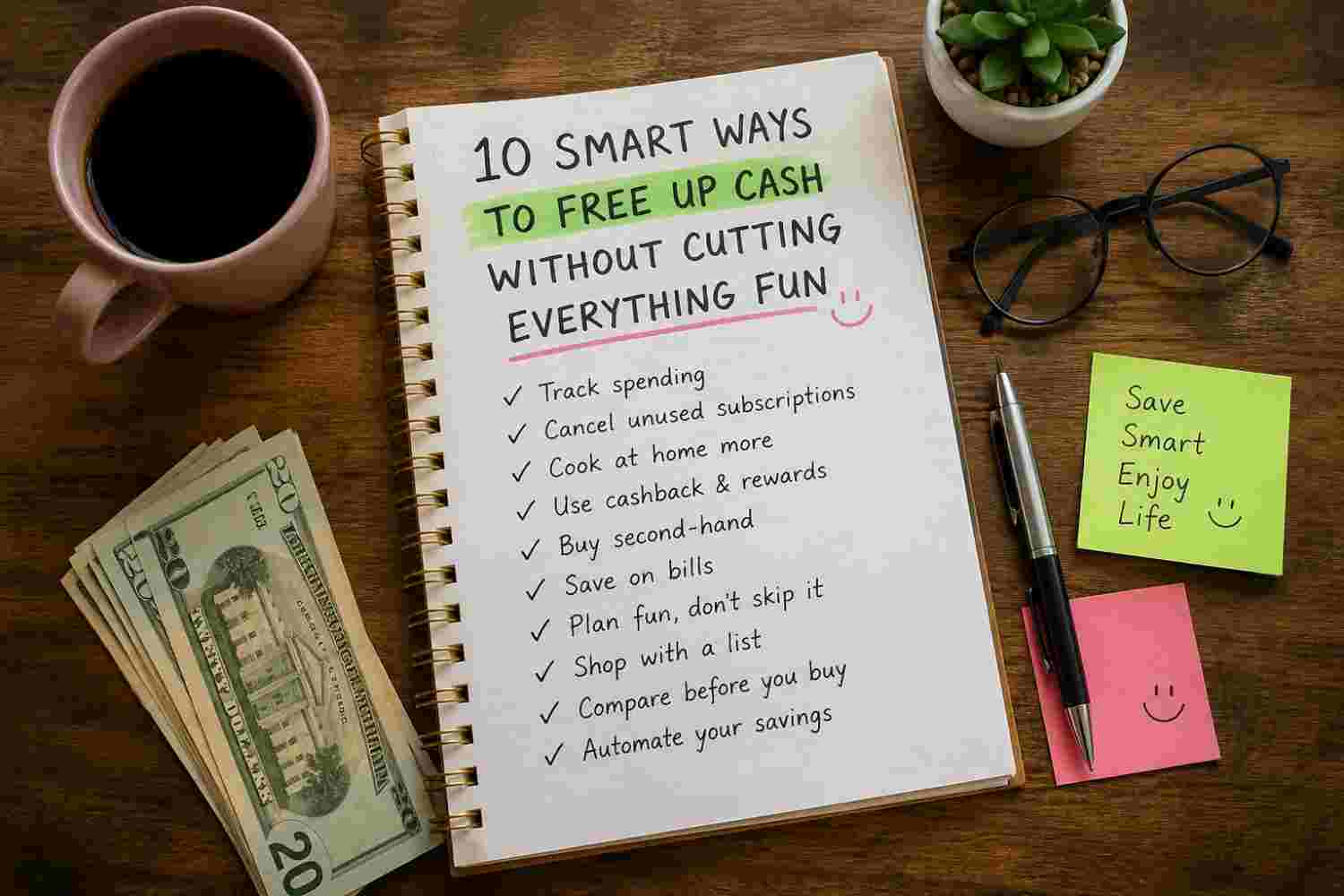
Saving money does not have to mean giving up every restaurant meal, weekend outing, or small purchase you enjoy. In fact, a budget that removes all fun can be so restrictive that it becomes difficult to maintain.
The better approach is to free up cash by spending more intentionally. Instead of asking, “What can I stop buying?” ask, “Where is my money going that does not add much value?” A few targeted changes can create meaningful room in your household budget without making everyday life feel miserable.
Here are 10 practical ways to reduce financial pressure while keeping the activities and purchases you genuinely enjoy.
1. Find Your Biggest Low-Value Expenses First
One of the fastest ways to free up cash is to stop focusing on tiny expenses before checking the big ones.
Saving $2 on coffee can help, but reducing a recurring $80 expense can have a much larger impact.
Review your last two or three months of spending and look for expenses that are:
- Recurring
- Larger than expected
- Rarely used
- Easy to replace
- No longer important to you
For example, imagine you discover that you spend $45 a month on subscriptions you barely use. Canceling them saves $540 per year without affecting groceries, transportation, or your favorite weekend activities.
Use a Three-Question Test
For each recurring expense, ask:
- Do I use this regularly?
- Would I notice if it disappeared?
- Is there a cheaper way to get the same value?
If the answer to the second question is “no,” that expense deserves closer attention.
The goal is not to eliminate everything enjoyable. It is to remove spending that provides little enjoyment or practical benefit.
2. Keep Your Favorite Treats and Reduce the Rest
A common budgeting mistake is trying to cut every form of entertainment.
Instead, identify the things you genuinely enjoy and protect them.
Suppose you enjoy going out for dinner twice a month. You do not necessarily need to eliminate both meals.
You could keep your favorite dinner while reducing spending elsewhere, such as:
- Ordering delivery less often
- Choosing fewer impulse purchases
- Cooking simple meals on busy weekdays
- Canceling unused subscriptions
- Reducing convenience fees
This creates a value-based budget.
You spend less overall while protecting the purchases that matter most to you.
Create a “Worth It” List
Write down five to ten things you are happy to spend money on.
These might include:
- Eating at a favorite restaurant
- Concerts
- Travel
- Books
- Fitness
- Hobbies
- Family activities
- Gaming
Then identify spending that does not make the list.
This simple exercise can reveal an important difference between spending money and getting value from money.
3. Audit Your Subscriptions
Subscriptions are easy to overlook because each individual payment may seem small.
A $10 subscription does not feel significant. Five $10 subscriptions, however, cost $50 a month or $600 a year.
Review your:
- Streaming services
- Music platforms
- Cloud storage
- Fitness memberships
- Apps
- Gaming services
- News subscriptions
- Software subscriptions
- Membership programs
Do not automatically cancel everything.
Instead, classify each service as:
Keep: You use it often and value it.
Pause: You use it occasionally and can restart it later.
Cancel: You rarely use it or forgot you had it.
If you rotate entertainment subscriptions rather than keeping several active at once, you can still enjoy different services without paying for all of them year-round.
4. Reduce Food Waste Instead of Eliminating Restaurant Meals
Free Up Cash is one of the largest flexible household expenses, but cutting every restaurant meal is not always realistic.
A better strategy is to reduce food waste and convenience spending.
Start by checking what you already have before grocery shopping.
For example, if your refrigerator contains vegetables, eggs, rice, and chicken, you may already have the ingredients for several meals.
Try a “Use It First” Night
Choose one evening each week when you prepare a meal using ingredients that need to be eaten soon.
This can help reduce:
- Spoiled produce
- Forgotten leftovers
- Duplicate purchases
- Last-minute takeout
You can also keep a few inexpensive backup meals available for busy days.
The purpose is not to make every meal perfectly cheap. It is to prevent convenience spending from becoming automatic.
If you enjoy dining out, budget for it deliberately instead of treating it as a financial failure.
5. Lower Recurring Bills Once, Then Benefit Every Month
Free Up Cash Some of the best savings require effort only once.
Review recurring household bills such as:
- Internet
- Mobile phone service
- Insurance
- Electricity plans where alternatives are available
- Banking fees
- Software services
- Memberships
Ask providers whether there are Free Up Cash that still meet your needs.
For example, if switching to a suitable mobile plan saves $20 per month, that is $240 per year from one decision.
Check Insurance Regularly
Insurance costs can change over time.
Depending on your location and circumstances, comparing available policies or asking about discounts may reveal opportunities to reduce premiums.
Do not reduce important coverage simply to save money. The goal is to find a better-value option that still provides appropriate protection.
6. Use a 24-Hour Rule for Nonessential Purchases
Impulse spending often happens because the decision and purchase occur almost simultaneously.
Free Up Cash is to create a waiting period.
For nonessential purchases above a certain amount, wait 24 hours before buying.
For larger purchases, you might wait several days.
This does not mean you can never buy something you want. It gives you time to determine whether you actually want it or simply reacted to the moment.
Ask Three Questions Before Buying
Before making the purchase, ask:
- Would I still want this tomorrow?
- Do I already own something that does the same job?
- What else could this money accomplish?
If you still want the item after considering those questions, it may be a reasonable purchase.
This method works Free Up Cash well for online shopping because removing the immediate purchase decision can reduce unnecessary spending.
7. Make Convenience More Selective
Convenience has value, but it can become expensive when used automatically.
Examples include:
- Food delivery fees
- Frequent rides instead of public transportation or walking
- Last-minute purchases
- Premium delivery services
- Paying for small tasks you could easily handle yourself
You do not have to eliminate convenience.
Instead, decide which conveniences are genuinely worth paying for.
For example, ordering dinner after an exhausting workday may provide real value. Ordering delivery simply because you do not feel like cooking may be something you can reduce.
The goal is to turn convenience into a deliberate choice rather than a default setting.
8. Plan Your Fun Spending Before the Month Starts
Fun spending becomes easier to control when it has a defined place in your budget.
Instead of saying, “I should spend less,” give yourself a specific amount.
Suppose you have $250 available for discretionary spending each month.
You might divide it into:
- $100 for dining out
- $50 for entertainment
- $50 for hobbies
- $50 for spontaneous spending
If you spend $100 on a concert, you know how much remains for other activities.
This approach can reduce guilt because entertainment is already part of the plan.
Create a Guilt-Free Spending Category
A realistic household budget should contain some money for enjoyment.
Even a small amount can make a strict budget easier to maintain.
The important rule is that your fun money should be affordable and intentional.
Once it is gone, you can wait until the next budget period rather than taking money from rent, groceries, savings, or essential bills.
9. Save Money on Transportation Without Giving Up Your Life
Transportation costs can quietly consume a large part of a household budget.
Look beyond the price of fuel.
Consider the total cost of:
- Fuel
- Parking
- Insurance
- Maintenance
- Repairs
- Loan or lease payments
- Public transportation
- Ride services
You may find that changing a few habits creates significant savings.
For example, combining several errands into one trip can reduce unnecessary driving.
If practical, you might also:
- Walk short distances
- Use public transportation occasionally
- Share rides
- Work remotely when available
- Group errands by location
- Compare fuel prices
- Maintain your vehicle properly
You do not need to stop driving to reduce transportation spending.
Small changes become meaningful when repeated throughout the year.
10. Give Every Extra Dollar a Job
Freeing up cash is only useful if you know what you want the extra money to accomplish.
Otherwise, the money can disappear into new spending.
Suppose you reduce monthly expenses by $200.
Instead of allowing that $200 to become unplanned spending, assign it.
You could direct it toward:
- Emergency savings
- High-interest debt
- A future vacation
- Home repairs
- Annual bills
- Retirement savings
- Education
- A major purchase
Try the “Three-Bucket” Method
A simple approach is to divide freed-up cash among three purposes:
Security: Emergency savings or essential reserves.
Progress: Debt reduction or long-term financial goals.
Enjoyment: A controlled amount for things you value.
For example, a household freeing up $300 per month might decide on:
- $150 for financial security
- $100 for a major goal
- $50 for additional fun
There is no universal percentage. The important part is that the money has a purpose before it gets spent.
How to Find Extra Cash in Your Budget
If you want to start today, perform a simple spending audit.
Review your recent bank and card transactions and divide them into four groups:
Essential
Expenses required for basic living.
Valuable
Nonessential expenses that genuinely improve your life.
Convenient
Expenses that save time or effort but could sometimes be reduced.
Low-Value
Purchases that provide little benefit or are easily forgotten.
Start by reducing low-value spending.
Then examine convenience spending.
Do not begin by attacking everything in the valuable category.
This approach makes saving money feel less like punishment and more like optimization.
A Realistic Example of Freeing Up $300 a Month
Consider a household spending $4,000 per month.
After reviewing its expenses, it finds several opportunities:
- Unused subscriptions: $35
- Fewer delivery orders: $70
- Lower mobile plan: $25
- Reduced impulse shopping: $60
- Better grocery planning: $60
- Combined errands and transportation savings: $30
- Banking or other recurring fees: $20
Total potential savings: $300 per month.
That equals $3,600 over a year.
The household did not eliminate restaurants, hobbies, holidays, or every entertainment expense.
Instead, it removed several low-value costs and redirected the savings.
This is the core idea behind sustainable money management: small changes in several categories can create meaningful results without making your lifestyle miserable.
What Not to Do When Trying to Save Money
Aggressive cost-cutting can backfire.
Avoid building a budget that assumes you will never spend money on entertainment, social activities, or personal interests.
Also avoid cutting important protections simply because they appear expensive.
Be cautious about:
- Skipping necessary maintenance
- Canceling important insurance without understanding the consequences
- Ignoring essential health or safety expenses
- Relying on credit to maintain lifestyle spending
- Setting unrealistic grocery budgets
- Creating savings goals that leave no money for normal life
A budget should help you make better decisions, not create constant financial stress.
Turn One-Time Savings Into Permanent Cash Flow
When you find a way to reduce an expense, make the savings automatic.
For example, if you cancel a $30 monthly subscription, set up an automatic $30 transfer to savings.
If you save $50 by changing a service plan, redirect that $50 toward your financial goal.
This prevents lifestyle creep, where savings from one expense quietly get absorbed by another.
The real power of cutting expenses is not the lower bill itself. It is what you consistently do with the money afterward.
A Simple 30-Day Cash-Freeing Challenge
You can put these ideas into practice over the next month.
Week 1: Find the Leaks
Review recent transactions and identify subscriptions, impulse purchases, unnecessary fees, and convenience spending.
Week 2: Fix Recurring Costs
Review your major monthly services and look for better-value options.
Week 3: Protect Your Fun
Choose the activities and purchases you genuinely value. Give them a clear budget.
Week 4: Redirect the Savings
Calculate how much cash you freed up and automatically move it toward savings, debt, or another financial goal.
At the end of the month, review what worked.
Keep the changes that felt easy and produced meaningful results. Adjust the ones that were too restrictive.
FAQ
How can I save money without giving up entertainment?
Start by reducing low-value and forgotten expenses rather than eliminating everything enjoyable. Keep a specific entertainment budget so you can spend on activities you genuinely value.
What is the easiest way to free up cash each month?
Review recurring expenses first. Unused subscriptions, expensive service plans, unnecessary fees, and other automatic payments can often provide savings without changing your daily lifestyle significantly.
How much money should I save from cutting expenses?
There is no universal target. Even $50 or $100 per month can make a difference when consistently redirected toward an emergency fund, debt, or another financial goal.
Should I stop eating out to save money?
Not necessarily. If dining out is important to you, include it in your budget. Reducing frequency, choosing lower-cost options, or cutting delivery fees can preserve the experience while lowering the overall cost.
How do I stop spending the money I save?
Give the savings a specific purpose and automate the transfer. Moving the money into a separate savings account as soon as you receive income can prevent it from being absorbed by other spending.
Conclusion: Spend Less on What You Don’t Value
Freeing up cash does not require turning your life into a long list of things you cannot buy.
The smarter strategy is to protect the spending that genuinely matters while reducing costs that provide little value. Audit recurring bills, control convenience spending, reduce food waste, delay impulse purchases, and give every dollar you save a clear purpose.
Start with just three actions this month: cancel one low-value recurring expense, reduce one convenience cost, and automate the money you save.
Then repeat the process.
A sustainable budget is not about spending as little as possible. It is about making sure more of your money goes toward the things that actually improve your financial security and your life.