
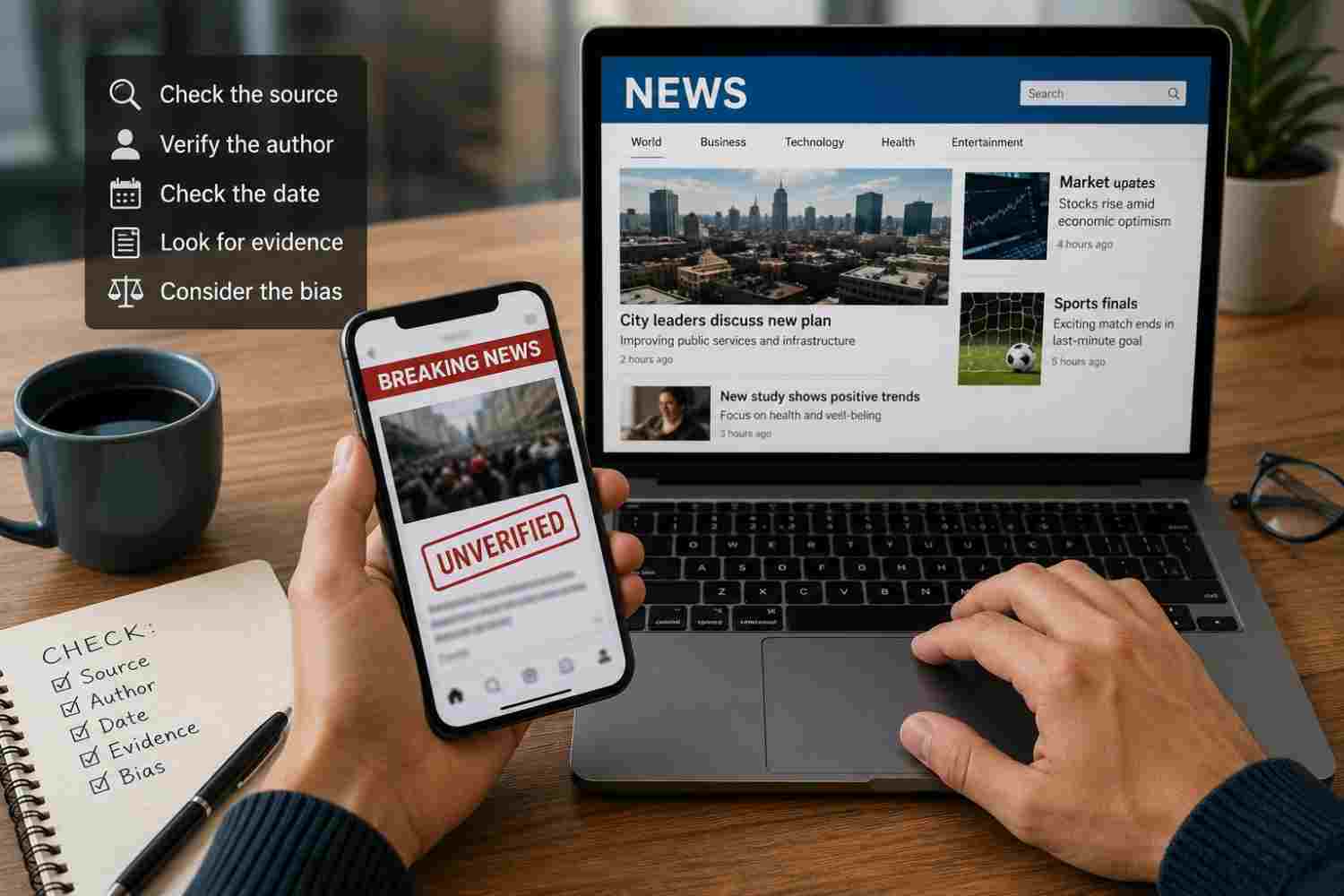
A dramatic headline can reach millions of people before anyone has checked whether the story is true. When news moves this quickly, knowing how to find reliable news sources is no longer just a useful skill—it is part of being an informed internet user.
The good news is that you do not need to become a professional journalist to verify what you read. A few simple habits can help you separate credible reporting from rumors, misleading headlines, recycled stories, and unsupported claims.
Why Reliable News Sources Matter More Than Ever
News travels at remarkable speed. A major event can appear on social media, messaging apps, video platforms, and news websites within minutes.
Speed creates a problem: the first version of a story is not always the most accurate version.
Early reports may contain incomplete information. Witnesses can misunderstand what happened. Social media users may share old photographs as if they are new. Even legitimate news organizations sometimes news update an article as more facts become available.
This is why it helps to distinguish between being first to see a story and being confident that the story is accurate.
A reliable news source generally does several things well:
- Identifies where information came from
- Separates verified facts from claims
- Corrects significant errors
- Provides relevant context
- Uses identifiable journalists or experts
- Avoids presenting rumors as established facts
- Explains what is known and what remains uncertain
The goal is not to find a source that agrees with everything you believe. The goal is to find reporting that gives you enough evidence to understand what is actually happening.
What Makes a News Source Reliable?
There is no single badge that automatically makes a publication trustworthy. Instead, look for several signals working together.
1. Check Who Published the Story
Start with the publisher.
Is it an established news organization with a visible editorial operation? Does the website provide information about its journalists, editors, ownership, and contact details?
A credible publication should make it reasonably easy to answer questions such as:
- Who wrote this?
- Who published it?
- When was it published?
- Where did the information come from?
- How can readers contact the organization?
Anonymous pages and websites with no clear editorial responsibility deserve more caution.
2. Look for Named Sources
Strong reporting usually tells readers where important information came from.
For example, news an article might say that a government department released a statement, a company published financial results, or researchers presented findings in a scientific journal.
That is much more useful than simply saying:
“Experts say this is going to change everything.”
Ask yourself: Which experts? What did they actually say?
The more important the claim, the more important it is to know its source.
3. Separate Reporting From Opinion
A news report and an opinion article can discuss the same event while serving completely different purposes.
News reporting generally focuses on verified developments, evidence, statements, and context.
Opinion writing presents an interpretation or argument from the writer or publication.
Neither format is automatically useless. The problem occurs when readers mistake commentary for straight reporting.
Look for labels such as:
- Opinion
- Editorial
- Analysis
- Commentary
- Guest contribution
Understanding these labels can dramatically improve the way you consume news.
How to Verify a Viral News Story
When a story is spreading rapidly, news, resist the temptation to immediately share it.
Instead, use a simple verification process.
Step 1: Read Beyond the Headline
Headlines are designed to attract attention. They cannot include every detail.
A headline might suggest that something happened “today,” while the article reveals that the event actually occurred weeks earlier.
Read at least the opening sections of the article before deciding what the story means.
Pay particular attention to:
- Publication date
- Location
- People involved
- Original source
- Specific claims
- Updates or corrections
Step 2: Search for Independent Coverage
One website can make a mistake. A second source can provide useful confirmation.
Search for the key event using neutral terms rather than copying a sensational headline.
For example, instead of searching:
“SHOCKING announcement that changes everything!!!”
search for:
“company announcement August 2026”
Then compare reporting from several reputable organizations.
You are not looking for identical wording. You are looking for agreement on the basic facts.
Step 3: Find the Original Source
This is one of the most powerful verification habits.
If an article says a politician, company, university, government agency, or researcher made a specific statement, try to locate the original document or announcement.
Depending on the story, the original source could be:
- An official government statement
- A company announcement
- A court document
- A research paper
- An election authority
- A public speech
- An official statistics release
The original source may not tell the entire story, but it can help you determine whether the claim being circulated is accurate.
Step 4: Check the Date
Old information is frequently recycled as breaking news.
This happens especially with photographs and videos.
A picture from a previous disaster can suddenly circulate during a new event. A years-old quote can be presented as a fresh statement. An old article can be reposted without its original date.
Always ask:
When did this actually happen?
That one question can prevent many false conclusions.
Be Careful With Social Media News
Social media is excellent for discovering that something is happening. It is much less reliable as the only source for determining what actually happened.
A post can spread because it is emotional, surprising, funny, or controversial. None of those qualities prove accuracy.
Watch for These Warning Signs
Be cautious when a viral post:
- Has no source
- Uses extreme language
- Claims everyone else is hiding the truth
- Tells readers to “share before it gets deleted”
- Uses an unexplained screenshot
- Provides no date or location
- Makes a huge claim without evidence
- Relies entirely on an anonymous account
A large number of shares is not evidence.
In fact, virality can sometimes make verification more important because inaccurate information can spread faster than corrections.
Learn to Recognize Misleading Headlines
A headline does not have to be completely false to be misleading.
Consider a hypothetical example:
“Scientists Discover That Coffee Improves Health.”
That sounds definitive.
But the article might actually describe a small observational study involving a specific population. The researchers may have said that the results show an association, not that coffee directly causes better health.
The difference between those statements matters.
Watch for words that turn limited evidence into certainty:
- Proves
- Guarantees
- Always
- Never
- Everyone
- Scientists confirm
- Experts agree
- Completely changes
The stronger the claim, the more evidence you should expect.
Compare News Sources Instead of Following Just One
Even reliable publications have different strengths.
A local publication may understand a community better than a global outlet. A specialist publication may provide deeper technical coverage than a general news website.
Instead of asking, “Which one news source is always correct?”, build a small collection of sources that serve different purposes.
For example:
| Source type | Best use |
|---|---|
| Local news | Community events and local developments |
| National news | Major domestic stories |
| International news | Global events |
| Specialist publications | Technical or industry-specific topics |
| Official sources | Primary statements and documents |
| Research publications | Scientific findings |
This approach gives you more context without requiring you to read hundreds of websites every day.
How to Find Reliable News Sources Online
Search engines can help you discover reputable reporting, but search ranking alone does not guarantee accuracy.
When you find a new publication, spend a few minutes evaluating it.
Check Its Editorial Standards
Look for pages explaining:
- Editorial policies
- Corrections
- Ethics standards
- Ownership
- Funding
- Contact information
A transparent publication gives readers a better understanding of how its journalism operates.
Examine Its Corrections
Nobody gets every story right.
A publication that acknowledges and corrects genuine mistakes may actually demonstrate stronger editorial accountability than a website that pretends it never makes errors.
Look for a visible correction policy or updated articles when appropriate.
Check the Author
Does the writer have a name and relevant background?
For specialist subjects, expertise matters.
A reporter covering technology, economics, medicine, climate science, or law may rely on specialist sources and explain complicated subjects more effectively than an anonymous account posting short claims.
Don’t Rely on One Source for Major Claims
For ordinary news, one credible report may be enough to understand what is happening.
For major or controversial claims, however, cross-checking is worthwhile.
Imagine that a viral post claims a country has introduced a major new law.
Before accepting the claim, check:
- A reputable news report
- The relevant government or legislative source
- Another independent publication
- The date and status of the law
You may discover that the proposal is real but has not yet become law.
That distinction can completely change the meaning of the story.
Understand the Difference Between Fact and Prediction
News articles often contain forecasts, estimates, and expert opinions.
These should not automatically be treated as facts.
For example:
Fact: A company announced a new product.
Prediction: Analysts expect the product to become popular.
The first statement can be verified directly. The second is an expectation that could prove wrong.
Good news reading means recognizing the difference.
What About AI-Generated News and Content?
Artificial intelligence has made it easier to create convincing text, images, audio, and video.
That does not mean everything created with AI is false. It does mean readers should pay closer attention to evidence and provenance.
If a striking image or video appears alongside a major claim, ask:
- Where did the original file come from?
- Is there independent footage?
- Does the location match the reported event?
- Was the material published previously?
- Are reputable organizations reporting the same event?
Do not rely on appearance alone. Modern synthetic media can look surprisingly realistic.
A Simple 5-Minute News Verification Routine
You do not need to investigate every article like a detective.
For an important story, try this quick routine:
1. Stop: Don’t immediately share the post.
2. Read: Open the full article instead of relying on the headline.
3. Check: Look at the date, author, publisher, and sources.
4. Compare: Search for independent reporting.
5. Verify: Find the original statement, document, data, or evidence when possible.
This process takes only a few minutes but can prevent you from spreading information that later turns out to be inaccurate.
Common Mistakes to Avoid When Reading News
Believing a Story Because It Matches Your Opinion
Confirmation bias affects everyone.
A claim can feel trustworthy simply because it supports what you already believe.
Instead, ask:
“What evidence would convince me that this claim is wrong?”
That question encourages more objective thinking.
Assuming Popular Means Accurate
Millions of views show that content attracted attention. They do not prove that it is true.
Reading Only the Headline
Important qualifications are often inside the article.
Treating Anonymous Posts as Evidence
An anonymous account may provide a useful lead, but a lead is not the same thing as verification.
Sharing Before Checking
If a story is genuinely important, spending a few minutes checking it will rarely hurt.
Build Better News Habits
Finding reliable news sources is only half the job. Your reading habits matter too.
Try these practical habits:
- Follow several credible publications rather than one.
- Read beyond headlines.
- Check dates before sharing.
- Look for primary sources.
- Separate facts from predictions.
- Be skeptical of emotionally extreme claims.
- Compare independent coverage.
- Avoid making decisions based on a single viral post.
- Take corrections seriously.
- Slow down when a story makes you unusually angry or excited.
The last point is particularly useful. Strong emotions can encourage quick reactions, while reliable news consumption usually benefits from patience.
FAQ About Reliable News Sources
What is the most reliable news source?
There is no single news organization that is perfect for every subject or country. Reliability is better judged by transparent sourcing, accurate reporting, corrections, editorial standards, and independent confirmation.
How can I tell if a news website is trustworthy?
Check who owns or operates the publication, whether articles identify their authors, whether important claims have sources, whether the site publishes corrections, and whether other credible organizations independently report the same facts.
Are social media news posts reliable?
Social media can be useful for discovering breaking events, but individual posts should not automatically be treated as verified news. Check the original source and independent reporting before accepting or sharing important claims.
How many news sources should I follow?
You do not need dozens. A small mix of reputable local, national, international, and specialist sources can provide broader coverage while keeping information manageable.
How do I verify a viral news story?
Read the full report, check its date and sources, search for independent coverage, and look for the original statement, document, data, or footage behind the claim.
Conclusion
When every story can become viral within minutes, finding reliable news sources requires a little more than clicking the first headline you see. The most useful habit is to slow down long enough to ask where the information came from and whether independent evidence supports it.
Read beyond headlines. Check dates. Identify sources. Compare reputable coverage. Find primary documents when possible. Most importantly, separate verified facts from opinions, predictions, and rumors.
You do not need to distrust everything you read. You simply need a better system for deciding what deserves your trust.
That small change can make you a more informed reader—and help stop inaccurate information from traveling one more click.