
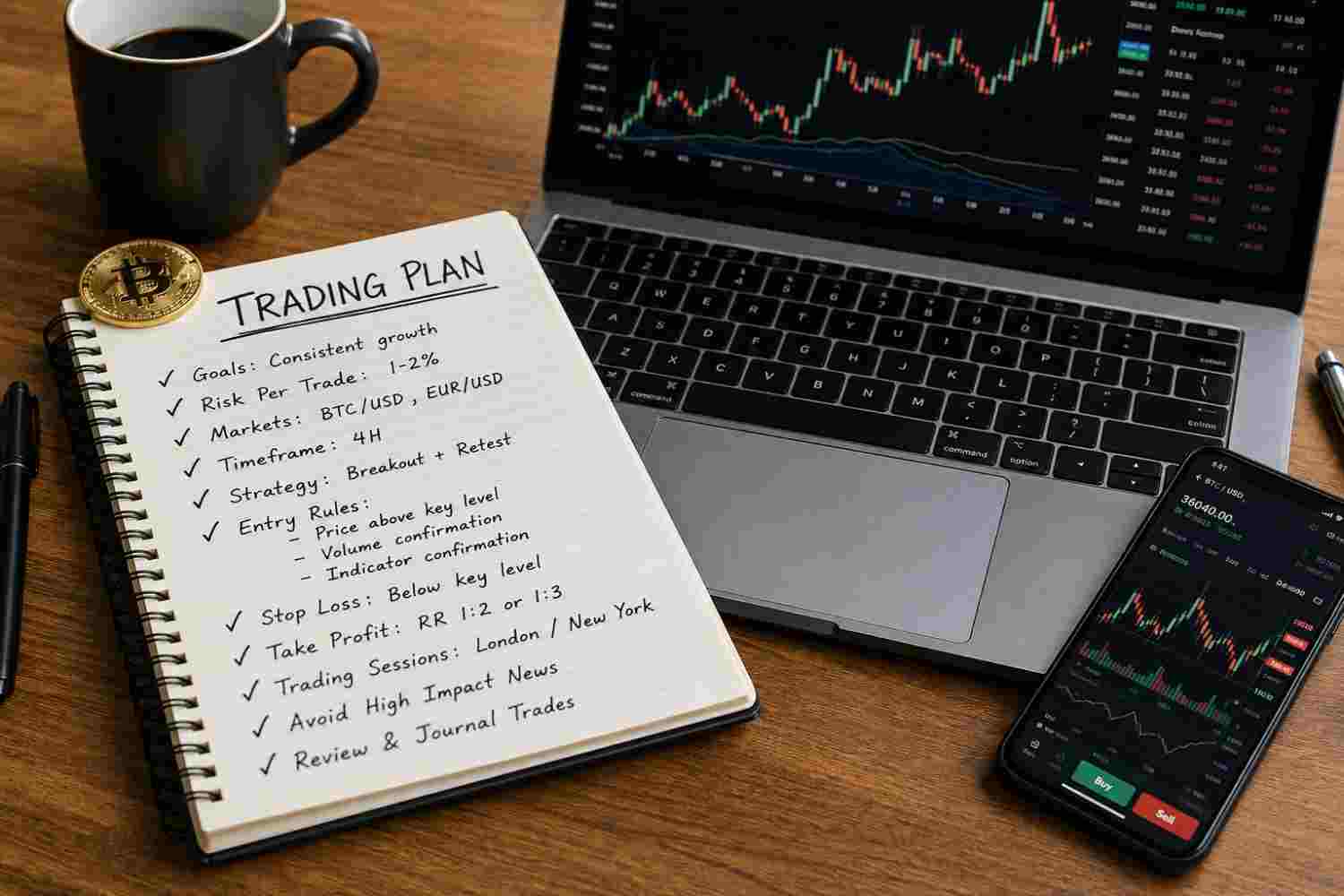
The hardest part of trading is often not finding a chart pattern. It is knowing what you will do before the market starts moving quickly.
A simple crypto and forex trading plan gives you rules for entering, managing, and exiting trades without making every decision based on fear, excitement, or a social media post. In 2026, that matters even more because traders have access to more markets, automated tools, signals, leverage products, and information than ever before.
This guide explains how to build a practical trading plan from scratch. You will learn how to choose markets, define risk, create entry and exit rules, manage trades, keep a trading journal, and improve your strategy without constantly changing it.
Important: This article is for educational purposes, not personalized financial advice. Crypto and forex trading can result in substantial losses. Only use money you can afford to lose, and understand the rules and protections that apply in your country.
What Is a Crypto and Forex Trading Plan?
A trading plan is a written set of rules that explains what you trade, when you trade, how much you risk, and when you exit.
Instead of saying:
“Bitcoin looks like it might go higher.”
a structured trader might say:
“I will consider a long trade only if my chosen setup appears on the 4-hour chart, my maximum risk is $20, and the trade offers at least a 1:2 risk-to-reward ratio.”
That difference is important.
A trading plan turns a vague idea into a repeatable process. It also gives Forex trading you something you can review later. If a strategy loses money, you can examine the rules and results instead of simply blaming the market.
A useful plan normally covers:
- Trading market and instruments
- Trading timeframe
- Entry conditions
- Stop-loss rules
- Profit-taking rules
- Position size
- Maximum risk per trade
- Maximum daily or weekly loss
- Trading schedule
- News and event rules
- Record-keeping
- Rules for reviewing performance
The goal is not to predict every market move. No trading plan can do that. The goal is to make your decisions more consistent.
Step 1: Decide What You Actually Want From Trading
Before choosing indicators or currency pairs, define your objective.
Are you trying to learn how markets work? Are you developing a short-term trading skill? Or are you interested in building a structured approach that you can test over time?
Your answer affects almost everything else.
For example, a beginner who works a full-time job may not have enough time to monitor one-minute crypto charts all day. A 4-hour or daily approach may be more realistic.
Write down:
- Your primary trading goal
- How many hours you can realistically spend trading
- How much money you can afford to risk
- Whether you prefer short-term or longer-term setups
- How comfortable you are with losing trades
- Whether you can follow rules under pressure
Do not use rent money, emergency savings, borrowed money, or money needed for essential expenses as trading capital. The CFTC specifically advises forex traders to determine their risk capital and avoid using funds needed for living expenses or savings goals.
For crypto, regulators likewise warn that losses can be significant and that investors should only risk money they can afford to lose entirely.
Step 2: Choose a Small Number of Markets
One common beginner mistake is trying to trade everything.
You do not need Bitcoin, Ethereum, 20 altcoins, 15 currency pairs, forex gold, indices, and every market your platform offers.
Start small.
A simple Crypto Watchlist
You might begin by following:
- Bitcoin
- Ethereum
- One or two additional liquid crypto assets
A simple forex watchlist
You might focus on major pairs such as:
- EUR/USD
- GBP/USD
- USD/JPY
- AUD/USD
The exact instruments should depend on your location, broker or exchange, account structure, costs, and experience.
The advantage of a smaller watchlist is familiarity. You start noticing how a market behaves around major sessions, economic announcements, volatility spikes, and support or resistance levels.
Crypto also has a different market structure from traditional forex. Crypto markets can trade around the clock, while forex activity is strongly influenced by global trading sessions.
Step 3: Pick One Trading Timeframe
Your timeframe should match your lifestyle.
A person who can check charts only twice a day should not build a strategy that requires constant monitoring.
Here is a simple framework:
| Trading style | Typical chart focus | Time commitment |
|---|---|---|
| Short-term | 5-minute to 15-minute | High |
| Day trading | 15-minute to 1-hour | Moderate to high |
| Swing trading | 4-hour to daily | Moderate |
| Longer-term | Daily to weekly | Lower |
These are general categories rather than strict rules.
For beginners, a slower timeframe can make it easier to avoid impulsive decisions. Fast charts create more signals, but more signals do not automatically mean better opportunities.
Step 4: Create Clear Entry Rules
Your entry rules should be specific enough that another person could understand what you are waiting for.
Avoid rules such as:
- “Enter when the market looks strong.”
- “Buy when momentum feels good.”
- “Sell when the chart looks overbought.”
These statements are too subjective.
Instead, define conditions.
For example, a hypothetical swing-trading setup might require:
- Price is above a chosen moving average.
- The broader trend is bullish.
- Price pulls back toward a previously identified support area.
- A predefined confirmation signal appears.
- The planned stop-loss provides acceptable risk.
- The potential reward meets your minimum risk-to-reward requirement.
This does not make the strategy profitable automatically. It simply makes the strategy testable.
That distinction is crucial.
Step 5: Decide How Much You Are Willing to Risk
Risk management is the foundation of a trading plan.
Suppose your account contains $2,000 and you decide that your maximum planned loss on one trade is 1%.
Your risk budget would be:
$2,000 × 1% = $20
That does not mean you should automatically buy $20 worth of crypto or open a $20 forex position.
Your position size depends on the distance between your entry and stop-loss.
A basic position-size concept
A simplified formula is:
Position Size = Maximum Dollar Risk ÷ Stop-Loss Distance
For example, imagine:
- Account: $2,000
- Maximum risk: $20
- Planned loss per unit if stopped: $0.50
Then:
$20 ÷ $0.50 = 40 units
This is a simplified educational example. Actual Forex trading and Crypto position sizing can involve contract specifications, pip values, fees, funding costs, spreads, slippage, leverage, and other factors.
The key idea is simple:
Choose the risk first. Then calculate the position.
Do not choose a huge position first and decide afterward how much loss you can tolerate.
Step 6: Use Stop-Loss Rules Carefully
A stop-loss is an instruction designed to close a position when the market reaches a predetermined level.
However, simply placing a stop does not make a trade safe.
A stop should be connected to your trading idea.
For example, if your bullish setup becomes invalid below a specific support structure, Forex trading your stop might be placed beyond that invalidation point.
Avoid placing a stop at an arbitrary distance simply because you want to risk a certain dollar amount.
Instead:
- Identify where your trade idea becomes invalid.
- Determine the distance from entry to that level.
- Calculate the position size that fits your risk limit.
- Include transaction costs where appropriate.
This approach keeps the market structure and risk management connected.
Step 7: Set Profit-Taking Rules Before Entering
A good trading plan should explain how you will exit when a trade moves in your favor.
Possible approaches include:
- Fixed risk-to-reward targets
- Previous support or resistance
- Trailing stops
- Partial profit-taking
- A technical exit signal
- A combination of these methods
For example, suppose you risk $20 on a trade and your plan targets a 1:2 risk-to-reward ratio.
The planned reward would be:
$20 × 2 = $40
This does not mean every trade will reach $40 profit. It simply defines the planned relationship between potential loss and potential gain.
You should also decide in advance what happens if the trade reaches an intermediate level.
Will you close part of the position? Move the stop? Do nothing?
Write the answer into your plan instead of deciding emotionally after the trade opens.
Step 8: Build Rules for Leverage
Leverage deserves its own section because it can dramatically change risk.
Forex trading commonly involves margin, and leverage can amplify both gains and losses. The CFTC warns that traders can lose their margin and, depending on the arrangement, may potentially be liable for losses beyond their initial deposit.
Crypto platforms can also offer leveraged products, which can magnify market movements.
For a beginner-friendly plan, consider making these rules explicit:
- Never use leverage simply because it is available.
- Set a maximum leverage level before trading.
- Calculate the potential loss before opening the position.
- Understand liquidation or margin rules for the specific product.
- Avoid increasing leverage after a losing trade.
- Never use leverage to compensate for a small account.
A smaller position with a clearly defined risk is generally easier to manage than an oversized position.
Step 9: Create a News and Volatility Rule
Markets can move sharply around major economic announcements and unexpected events.
Forex traders may pay particular attention to events such as:
- Central-bank interest-rate decisions
- Inflation reports
- Employment data
- GDP releases
- Major economic speeches
Crypto traders also need to consider:
- Major regulatory announcements
- Exchange problems
- Network upgrades
- Security incidents
- Large market-wide news
- Sudden liquidity changes
You do not necessarily have to stop trading around every event. Instead, create a rule.
For example:
“I will not open a new position shortly before a major scheduled economic release unless my strategy has been specifically tested for that condition.”
That is far better than making the decision while watching a market suddenly move.
Step 10: Check the Platform Before Trading
A trading strategy is only one part of the risk equation. Your choice of broker, exchange, or other trading platform also matters.
For forex, the CFTC recommends researching OTC forex dealers and checking registration and disciplinary information where applicable. It also warns that some fraudulent operations use social media, messaging apps, unrealistic return promises, and unregistered platforms to attract customers.
For crypto, custody deserves attention too. A 2025 SEC investor bulletin explains that crypto wallets generally store the private keys used to access crypto assets rather than storing the assets themselves.
Before funding an account, check:
- Who operates the platform
- Which country or jurisdiction governs it
- Available withdrawal methods
- Trading fees and spreads
- Margin and liquidation rules
- Security features
- Account recovery procedures
- Relevant registration or licensing information
- Whether the product is actually available legally in your jurisdiction
Never assume that a popular app, influencer recommendation, or attractive website means a platform is safe.
Step 11: Write Your Complete Trading Plan
Now bring everything together.
A simple one-page plan could look like this:
My 2026 Trading Plan
Markets: Selected crypto assets and major forex pairs
Style: Swing trading
Primary timeframes: 4-hour and daily
Maximum risk per trade: 1% of trading capital
Entry: Only when all predefined setup conditions are present
Stop: Based on trade invalidation, not an arbitrary dollar amount
Profit target: Minimum planned risk-to-reward ratio defined before entry
Maximum trades per day: 2
Daily loss limit: Predefined before trading begins
News rule: Avoid new positions around selected high-impact events unless the strategy has been tested for them
No-trade conditions: Emotional decision-making, unclear setup, excessive spread, technical problems, or inability to monitor the position as required
Journal: Record every trade
The numbers above are examples, not universal recommendations. Your own risk limits should reflect your financial situation and experience.
Step 12: Keep a Trading Journal
A trading journal turns experience into usable information.
For every trade, record:
- Date and time
- Asset or currency pair
- Timeframe
- Entry price
- Stop-loss
- Target
- Position size
- Planned risk
- Actual result
- Reason for entry
- Reason for exit
- Market conditions
- Whether you followed your rules
- Screenshot, if useful
- Emotional state
The most valuable question after a losing trade is not:
“Why did the market do this?”
Ask:
“Did I follow my plan?”
A losing trade that followed your rules can be useful data. A profitable trade that broke your rules can be dangerous because it may reinforce bad behavior.
Step 13: Backtest Before Increasing Risk
Before committing meaningful capital, test your strategy against historical market data where practical.
You want to know:
- How often the setup appears
- How often it wins
- Average winning trade
- Average losing trade
- Largest losing streak
- Maximum drawdown
- Performance during different market conditions
- Whether transaction costs change the results
Do not change the rules after every few losses.
A strategy needs enough observations to produce meaningful information.
You can also use a demo or simulated environment to practice execution before increasing financial exposure. However, simulated results may differ from real trading because real markets involve execution pressure, fees, spreads, slippage, liquidity conditions, and emotions.
Common Mistakes to Avoid
Changing strategies after a few losses
Every strategy experiences losing trades. Constantly switching systems makes it almost impossible to determine what actually works.
Risking more after a loss
Trying to recover a loss immediately can turn one bad trade into several.
Your plan should prohibit emotional position increases.
Following social media signals blindly
A screenshot showing a profitable trade tells you almost nothing about the person’s complete trading history or risk.
The CFTC specifically warns about social-media-driven forex fraud and promises of unusually high or guaranteed returns.
Using too many indicators
Five indicators do not necessarily provide five independent reasons to trade.
Start with a small number of tools that you understand.
Ignoring fees and trading costs
A strategy can look attractive before costs and much weaker after spreads, commissions, funding costs, and slippage.
Treating leverage as a shortcut
Leverage increases exposure. It does not create trading skill.
Crypto vs Forex: Should Your Plan Be Different?
Yes.
The basic framework can be similar, but the details should reflect the market.
| Factor | Crypto | Forex |
|---|---|---|
| Trading hours | Often available around the clock | Closely tied to global market sessions |
| Volatility | Can be very high | Varies by pair and market conditions |
| Main risks | Volatility, custody, platform and regulatory risks | Leverage, dealer, market and execution risks |
| News drivers | Regulation, technology, market sentiment | Rates, inflation, employment, economic policy |
| Risk approach | Position size should reflect potentially large price swings | Position size should account for pip value and leverage |
Crypto asset markets can be exceptionally volatile and speculative, while retail OTC forex trading also carries significant risks, particularly when leverage is involved.
Therefore, do not copy a forex strategy into crypto unchanged—or assume a crypto risk model automatically works for forex.
How to Improve Your Trading Plan in 2026
Your first plan does not need to be perfect.
Treat it as a working document.
Review it at a regular interval, such as every 20–50 completed trades, rather than rewriting it after every loss.
Look for patterns:
- Which setups perform best?
- Which markets cause the most mistakes?
- Are losses larger than planned?
- Are profitable trades being closed too early?
- Are you trading outside your scheduled hours?
- Are fees significantly affecting results?
- Are certain market conditions consistently producing poor outcomes?
Then make one controlled change at a time.
If you change five rules simultaneously, you will not know which change helped or hurt.
Frequently Asked Questions
Is crypto or forex better for beginners?
Neither is automatically better. Both can involve substantial risk. Forex can involve significant leverage, while crypto can experience sharp price movements and additional platform and custody risks. Beginners should focus on learning risk management and market mechanics before choosing a market.
How much money do I need to start trading?
There is no universal amount. The more important question is whether the amount represents money you can genuinely afford to lose. Account minimums, product specifications, fees, and local rules vary by platform and jurisdiction.
What should a trading plan include?
At minimum, include your markets, timeframe, entry rules, stop-loss method, profit-taking rules, position sizing, maximum risk, trading schedule, news rules, and journal process.
Is leverage necessary for crypto or forex trading?
No. Leverage is a tool, not a requirement for becoming a successful trader. Because leverage can amplify losses as well as gains, beginners should understand the product’s margin and liquidation rules before using it.
How often should I change my trading strategy?
Avoid changing it after every loss. First collect enough trade data to identify a meaningful pattern. Then test one adjustment at a time and compare the results.
Conclusion: Keep Your Trading Plan Simple
A strong crypto and forex trading plan does not need dozens of indicators, complicated formulas, or predictions about where Bitcoin or a currency pair will be six months from now.
It needs clear rules you can actually follow.
Start with a small watchlist. Choose a timeframe that fits your life. Define your entry conditions before you trade. Calculate your position size from your acceptable risk. Decide where the trade becomes invalid and where you will take profits. Add rules for leverage, major news, platform safety, and daily losses. Then record every trade and review the evidence.
Most importantly, build the plan around risk rather than excitement.
Markets will always provide another opportunity. Your job is to make sure one bad trade does not remove you from the game.
In 2026, the advantage is not having access to more charts, signals, or automated tools. It is having a simple process that keeps you disciplined when the market becomes unpredictable.