
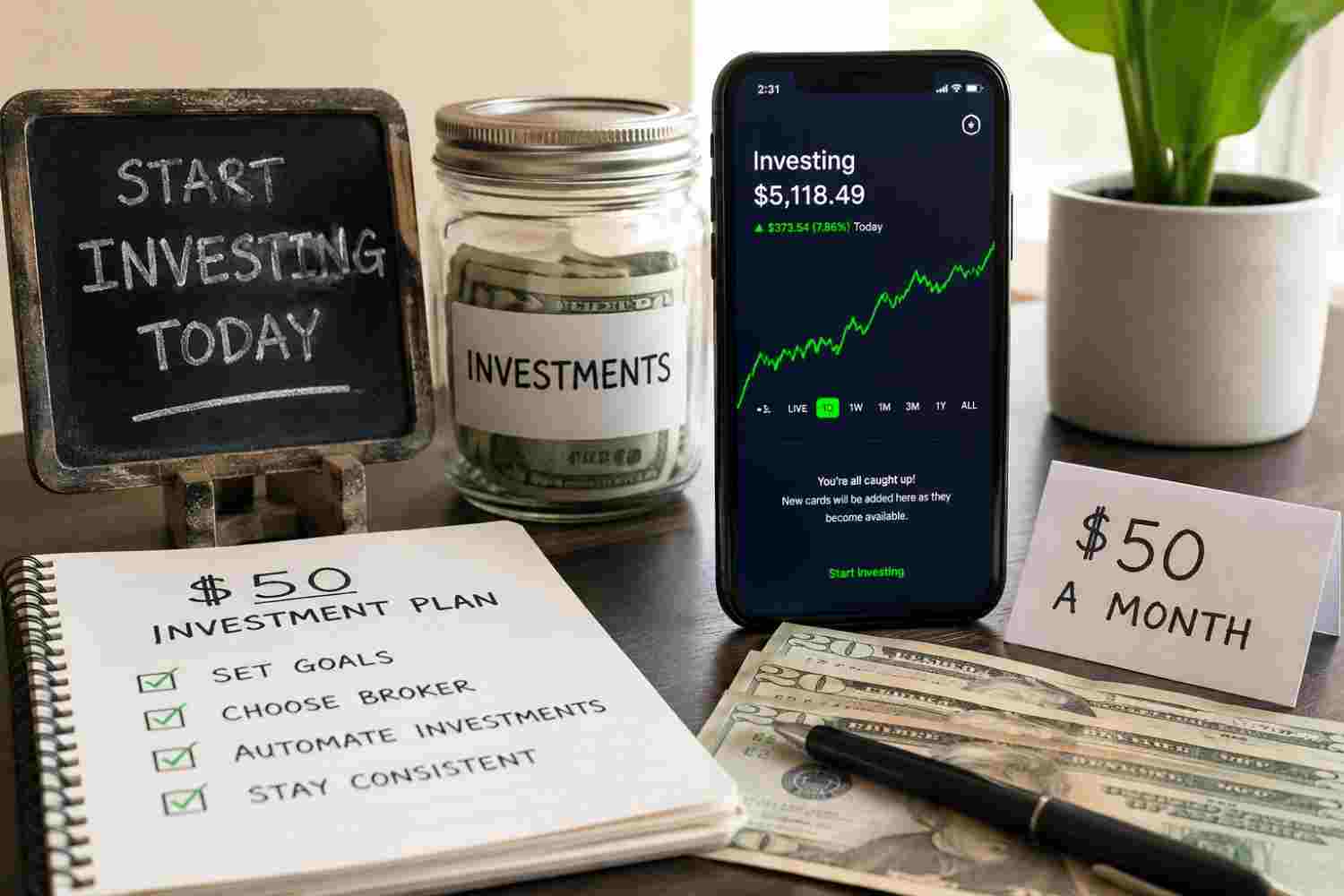
You don’t need a fat paycheck or a finance degree to start building wealth. You need $50, a phone, and about ten minutes to set things up. That’s it. In 2026, investing has become so accessible that skipping a few coffee runs a month is genuinely enough to get started — and the earlier you begin, the more time your money has to grow.
This guide walks you through exactly how to turn $50 a month into a real investment habit, using tools and platforms that actually exist today, not vague advice from a decade-old blog post.
Why $50 a Month Actually Matters
It’s easy to dismiss $50 as “too small to matter.” But that thinking keeps millions of people out of the market entirely, which is far more costly than starting small.
Here’s a simple example. If you invest $50 every month into a fund that averages a 7% annual return (a reasonable long-term average for a diversified stock index), here’s roughly what happens:
- After 5 years: about $3,570
- After 10 years: about $8,660
- After 20 years: about $25,900
- After 30 years: about $60,700
You only put in $18,000 over 30 years. The rest — over $42,000 — comes from compound growth. That’s the entire point of starting now instead of waiting until you “have more money.” Time does more work than the amount you contribute.
Step 1: Get Your Financial Foundation Right First
Before your first $50 goes anywhere, check two things.
Pay Off High-Interest Debt First
If you’re carrying credit card debt at 20%+ interest, $50 a Month that debt is growing faster than almost any investment will. Paying it down is, mathematically, a guaranteed “return” better than the stock market. A small emergency fund (even $300–$500) is also worth having so you’re not forced to sell investments if your car breaks down.
Pick the Right Account Type
This depends on your country, but the general categories are the same everywhere:
- Tax-advantaged retirement accounts — like a Roth IRA (U.S.), a Stocks & Shares ISA (U.K.), an RRSP/TFSA (Canada), or similar accounts in other countries. These often let your money grow tax-free or tax-deferred.
- Standard brokerage accounts — more flexible, no contribution limits, but usually taxed on gains.
If your country offers a tax-advantaged option and you’re investing for the long term, start there. It’s free extra return.
Step 2: Choose Where to Invest Your $50
You don’t need to pick individual stocks. In fact, for a beginner with $50 a month, that’s usually the wrong move. Here are the three most realistic options in 2026.
Index Funds and ETFs (Best for Most Beginners)
An index fund or ETF (Exchange-Traded Fund) bundles hundreds or thousands of companies into a single investment. Instead of betting on one company, you own a small slice of the whole market.
Popular beginner-friendly examples include:
- A total stock market ETF
- An S&P 500 ETF (tracks the 500 largest U.S. companies)
- A global or “world” index ETF, useful if you want exposure outside just one country
These typically have low fees (often under 0.20% per year) and don’t require you to watch the market daily.
Robo-Advisors
A robo-advisor is an app that builds and manages a diversified portfolio for you based on your goals and risk tolerance. You answer a few questions, set up your $50 monthly deposit, $50 a Month and the app handles the rest — rebalancing, diversification, sometimes even tax optimization.
This is a strong option if you want a “set it and forget it” approach without picking funds yourself.
Fractional Shares
Many brokerage apps now let you buy fractional shares, meaning you can own $50 worth of an expensive stock like Amazon or a real estate fund instead of needing hundreds or thousands of dollars for a full share. This opened investing up to people who previously couldn’t afford entry-level positions in popular companies.
Step 3: Automate It So You Never Have to Think About It
The single biggest reason people stop investing isn’t market crashes — it’s forgetting, or “meaning to get to it later.”
Set up an automatic transfer of $50 a Month from your bank account to your investment account on the same day each month, ideally right after you get paid. This does three things:
- Removes the temptation to skip a month
- Takes emotion out of the decision (you’re not trying to “time the market”)
- Builds a habit the same way automatic bill payments do
This strategy has a name: dollar-cost averaging. You invest the same amount regularly, regardless of whether prices are up or down. Over time, this smooths out the ups and downs of the market instead of you trying to guess the “perfect” moment to buy.
Step 4: Keep Fees Low — They Quietly Eat Your Returns
With only $50 a month, fees matter more than people realize. A 1% annual fee doesn’t sound like much, but over 30 years it can eat tens of thousands of dollars from your final balance compared to a fund charging 0.10%.
What to check before choosing a platform:
- Expense ratio — the annual fee charged by a fund. Look for under 0.20% when possible.
- Account maintenance fees — some brokerages charge a flat monthly fee regardless of balance. Avoid these if you’re starting small.
- Trading commissions — most major platforms in 2026 offer commission-free trades on stocks and ETFs, so there’s rarely a reason to pay per-trade fees anymore.
Step 5: Diversify Even With a Small Budget
Diversification just means not putting all your money in one place. With $50 a month, you can still diversify easily by choosing:
- One broad index fund covering the total stock market, or
- A target-date fund that automatically adjusts your mix of stocks and bonds as you age, or
- A pre-built robo-advisor portfolio that already spreads your money across multiple asset types
You don’t need ten different funds. One or two well-chosen, diversified funds are enough for most beginners.
Common Mistakes to Avoid
- Waiting for “extra money.” There’s rarely a month where $50 magically becomes easy. Treat it like a bill.
- Checking your balance daily. Short-term swings are normal and meaningless for a long-term goal. Check monthly or quarterly at most.
- Chasing hot stocks or trends. Meme stocks, hype coins, and “guaranteed” tips are how beginners lose money fast. Boring and consistent wins long term.
- Stopping contributions during a downturn. Market dips are actually when your $50 buys more shares for the same price — a hidden advantage of investing regularly.
- Ignoring the account type. Investing outside a tax-advantaged account when one was available means giving up free tax savings for no reason.
A Realistic 2026 Starter Plan
If you’re not sure where to begin, here’s a simple path:
- Build a small starter emergency fund (even $200–$300).
- Open a tax-advantaged account if your country offers one.
- Choose one low-fee, diversified index fund or a robo-advisor portfolio.
- Set up an automatic $50 monthly transfer.
- Increase the amount by $10–$20 whenever your income grows.
- Leave it alone and revisit your plan once or twice a year.
That’s genuinely the whole strategy that most long-term investors follow — the complexity people imagine simply isn’t necessary at this stage.
FAQ: Investing With $50 a Month
Is $50 a month actually enough to make a difference? Yes. It’s less about the amount and more about consistency and time. Someone investing $50 a month for 30 years can end up with significantly more than someone investing $200 a month for only 5 years, purely because of how compound growth works.
What’s the safest way to invest $50 a month as a beginner? A broad, low-fee index fund or a robo-advisor portfolio is generally considered the safest starting point for beginners, since it spreads risk across many companies instead of relying on one stock.
Do I need a financial advisor to start with $50? No. Most people starting with small monthly amounts use a robo-advisor or a simple index fund app instead, $50 a Month since traditional financial advisors often have account minimums or fees that don’t make sense for small contributions.
What happens if I miss a month or need to stop temporarily? Nothing bad happens. You can pause or restart automatic contributions anytime. It’s better to pause during a genuine financial squeeze than to go into debt to keep investing.
Should I invest in crypto with my $50 instead of stocks? Cryptocurrency is far more volatile than diversified index funds, meaning bigger potential swings in both directions. Most financial experts suggest keeping crypto, if you choose to include it at all, to a small percentage of a portfolio rather than your main $50 monthly investment.
Final Thoughts
Starting with $50 a month isn’t a “starter version” of real investing — it is real investing. The habit you build now, the automation you set up, and the years you stay consistent matter far more than the size of your first deposit. Open an account this week, set your automatic transfer, $50 a Month and let time do the heavy lifting from here.