
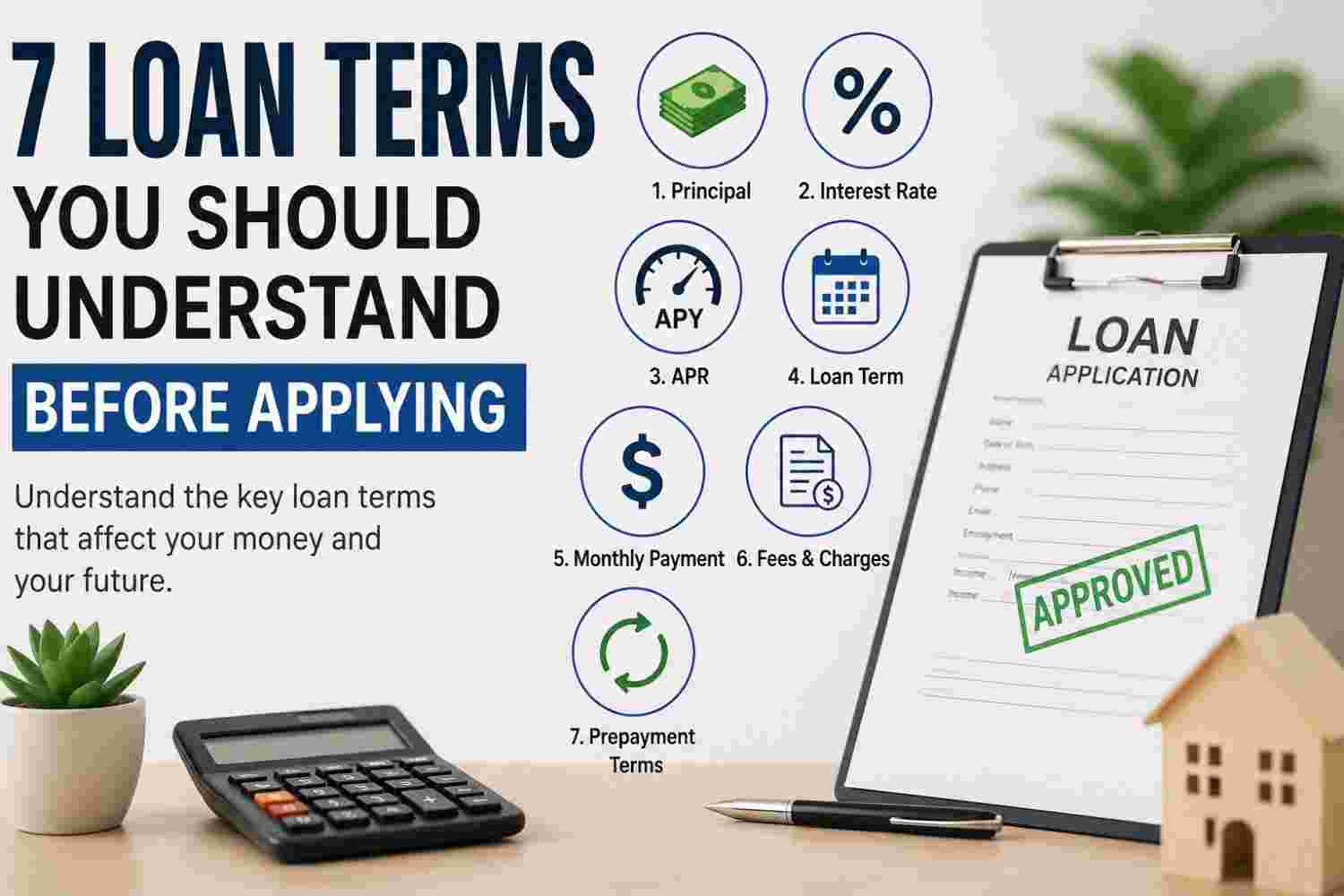
You find the perfect loan offer. The number at the top looks great. Then you scroll down and see words like “APR,” “amortization,” and “origination fee” — and suddenly you’re not sure what you’re actually agreeing to. That confusion costs people real money every year, because the terms buried in the fine print often matter more than the number on the homepage.
Loan paperwork isn’t written to confuse you on purpose, but it is written by people who deal with these words every day. To them, it’s routine. To you, loan it can feel like a different language. The good news is that you only need to understand a handful of key terms to read any loan offer with confidence — whether it’s a mortgage, a car loan, a personal loan, or a student loan.
Here are the seven terms that matter most, explained the way you’d explain them to a friend.
1. Principal
The principal is simply the amount of money you borrow, before any interest or fees are added.
If you take out a loan for $10,000, that $10,000 is your principal. Every payment you make chips away at two things: the principal and the interest. Early in most loans, a bigger chunk of your payment goes toward interest, and only a small part reduces the principal. Over time, that ratio flips.
Why it matters: If you ever want to pay off a loan faster, Loan ask your lender how to make an “extra principal payment.” Money applied directly to principal reduces the total interest you’ll pay over the life of the loan — sometimes by thousands of dollars.
2. Interest Rate vs. APR
This is the one that trips up the most people, because these two numbers look similar but mean very different things.
- Interest rate is the cost of borrowing the principal, shown as a percentage. It tells you how much extra you’ll pay just on the loan amount itself.
- APR (Annual Percentage Rate) includes the interest rate plus most of the fees the lender charges — like origination fees or processing costs — spread out over a year.
Real example: Imagine two loans for $5,000. Loan A has a 6% interest rate but a $200 origination fee. Loan B has a 6.5% interest rate with no fees. On paper, Loan A looks cheaper because of the lower rate. But once you factor in the fee, Loan A’s APR might actually come out higher than Loan B’s. The APR is what lets you compare them fairly, apples to apples.
Why it matters: Always compare APR, not just the interest rate, loan when shopping for loans. A lower interest rate with high fees can end up costing more than a slightly higher rate with no fees.
3. Loan Term
The loan term is the length of time you have to repay the loan — often written in months or years.
For example, a car loan might have a 60-month term, while a mortgage might stretch to 30 years. A shorter term usually means higher monthly payments but less interest paid overall. A longer term means smaller monthly payments but more interest paid over time, since interest has more time to add up.
Real example: Borrow $20,000 at 7% interest. Over a 3-year term, you might pay around $2,200 in total interest. Stretch that same loan to a 6-year term, and total interest could climb to roughly $4,500 — even though the monthly payment is much lower.
Why it matters: Don’t just pick a term based on what fits your monthly budget. Look at the total cost of the loan across the full term before deciding.
4. Amortization
Amortization is the schedule that shows exactly how each payment is split between principal and interest over the life of the loan.
Most loans — mortgages, auto loans, and many personal loans — are “amortized,” meaning you pay a fixed amount on a regular schedule until the loan is fully paid off. What changes each month is the mix inside that payment.
Here’s a simplified breakdown of a $10,000 loan at 6% interest over 5 years:
- Month 1: About $50 goes to interest, the rest to principal
- Month 30 (halfway): Roughly $27 goes to interest
- Month 60 (final payment): Almost the entire payment goes to principal
Why it matters: Understanding amortization explains why paying off a loan early saves more money in the first few years than in the last few. It also helps you understand loan payoff quotes, loan which are usually higher than you’d expect from simply multiplying your monthly payment by the months remaining.
5. Origination Fee
An origination fee is a one-time charge some lenders take for processing your loan application and setting it up. It’s usually a percentage of the loan amount, commonly between 1% and 8%.
Real example: On a $15,000 personal loan with a 5% origination fee, you’d be charged $750. Some lenders deduct this fee directly from the amount they send you — so you might apply for $15,000 loan but only receive $14,250 in your account, while still owing the full $15,000.
Why it matters: Always ask whether the fee is deducted from your loan proceeds or added to your balance. This detail changes how much cash you actually have in hand versus how much you owe.
6. Collateral and Secured vs. Unsecured Loans
Collateral is something valuable — like a car, a house, or savings — that you pledge to the lender as a backup. If you stop making payments, the lender can seize the collateral to recover their money.
This is the key difference between two loan categories:
- Secured loans require collateral (mortgages, auto loans, secured credit cards). They tend to have lower interest rates because the lender has less risk.
- Unsecured loans don’t require collateral (most personal loans, credit cards). They tend to have higher interest rates because the lender is taking on more risk if you default.
Why it matters: Before signing a secured loan, be completely honest with yourself about your ability to keep up with payments. Missing payments on a secured loan doesn’t just hurt your credit — it can mean losing the actual asset tied to it.
7. Prepayment Penalty
A prepayment penalty is a fee some lenders charge if you pay off your loan early or pay significantly more than your scheduled payment. It sounds backwards — why would paying early cost you money? — but lenders add this because early payoff means they collect less interest than they planned on.
Not all loans have this. Many personal loans and federal student loans don’t charge one. But some mortgages and auto loans still do, especially if paid off within the first few years.
Real example: A mortgage with a 2% prepayment penalty on a $200,000 remaining balance would cost $4,000 if paid off early within the penalty period. That’s a significant, loan easy-to-miss cost if you’re planning to refinance or sell your home soon after taking out the loan.
Why it matters: If there’s any chance you’ll pay off the loan early — through a bonus, an inheritance, refinancing, or selling an asset — ask about prepayment penalties before you sign anything.
Putting It All Together: A Quick Checklist
Before you apply for any loan, run through this list:
- What’s the principal, and does it match what you actually need?
- What’s the APR — not just the interest rate — and how does it compare to other offers?
- What loan term are you choosing, and what’s the total interest cost over that full term?
- Have you looked at the amortization schedule to see how payments are split early versus late?
- Is there an origination fee, and is it deducted from your funds or added to your balance?
- Is the loan secured or unsecured, and what collateral, if any, is at risk?
- Is there a prepayment penalty if you pay it off ahead of schedule?
Walking into a loan application with these seven terms in hand changes the entire experience. You stop nodding along to numbers you don’t fully understand and start asking the questions that actually protect your money.
Frequently Asked Questions
1. What’s the difference between interest rate and APR? Interest rate is the cost of borrowing the principal amount. APR includes that interest rate plus most lender fees, loan giving you a more complete picture of the loan’s true annual cost.
2. Does a longer loan term always cost more? Not necessarily in total dollars for smaller loans, but generally yes — a longer term usually means more interest paid overall, loan even though the monthly payment is smaller. Always check total interest cost, not just monthly payment.
3. Can I avoid an origination fee? Some lenders don’t charge one at all, so it pays to compare offers. Others may waive or reduce the fee if you have strong credit or negotiate directly.
4. What happens if I can’t repay a secured loan? The lender can seize the collateral — such as your car or home — to recover what’s owed. This is different from unsecured loans, where the lender can’t automatically take a specific asset but may pursue other collection methods.
5. Is it always smart to pay off a loan early? Usually, yes, since it reduces total interest paid. But check for a prepayment penalty first — in some cases, loan the penalty can outweigh the interest savings, especially if you’re close to the end of the loan term.