
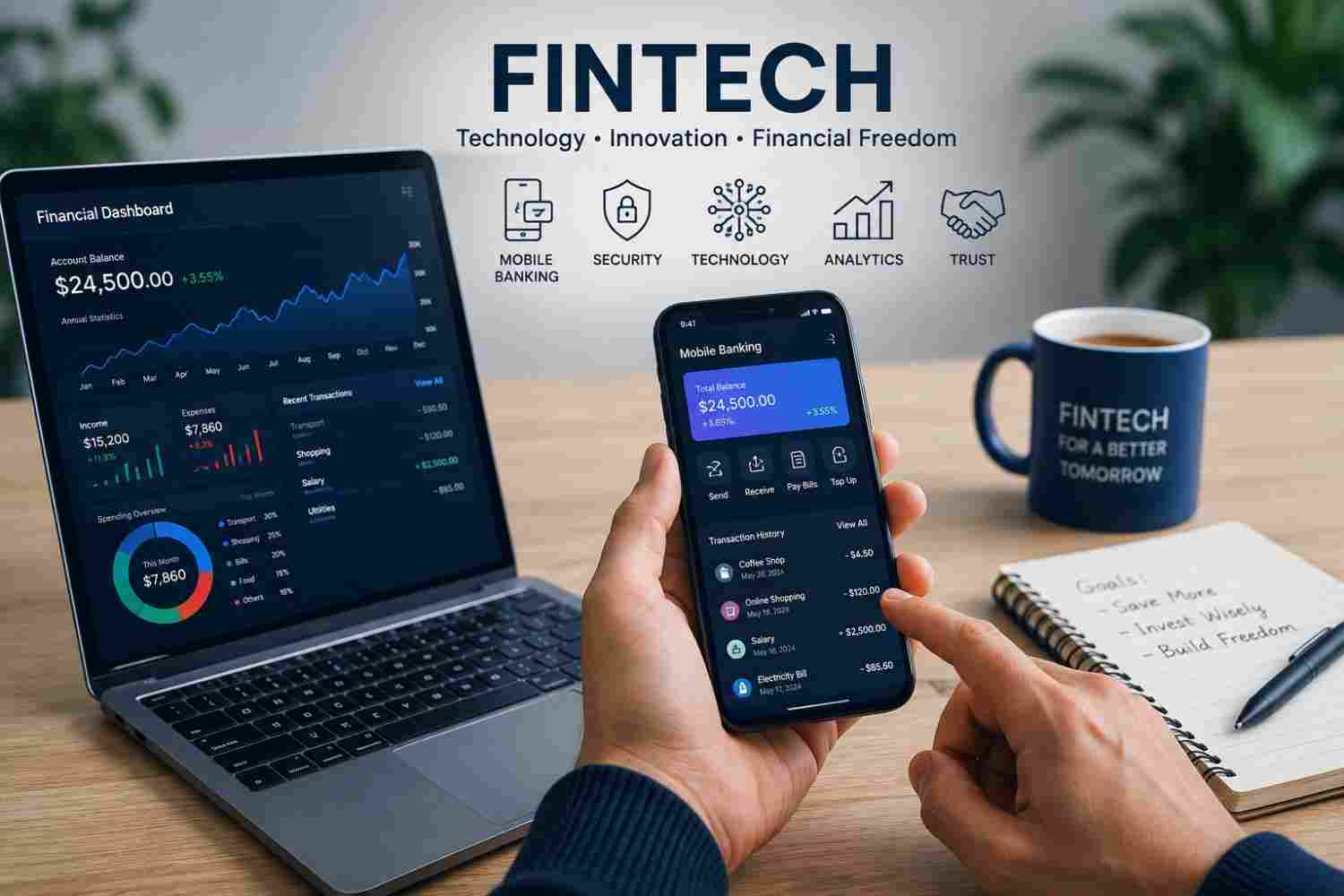
Your customers already expect money to move as fast as a text message. If your business still treats payments, lending, or compliance like it’s 2015, you’re not just behind — you’re invisible to a generation that has never waited three days for a bank transfer to clear.
Fintech isn’t a side industry anymore. It’s the plumbing underneath retail, healthcare, logistics, and almost every app on your phone. The technologies below aren’t hype-cycle buzzwords. They’re already running inside banks, checkout pages, and supply chains, and their influence is only going to grow. Here’s what to actually pay attention to — and why it matters for your business.
1. AI Agents That Actually Do the Work
For years, “AI in finance” meant a chatbot that could answer basic questions. That’s changed. AI agents now handle multi-step tasks on their own: reconciling accounts, flagging suspicious transactions, fintech negotiating small vendor invoices, and even approving routine loans within preset rules.
The difference between a chatbot and an agent is simple: a chatbot answers questions, an agent takes actions. Large banks are already using agents to draft compliance reports and triage fraud alerts before a human ever sees them. Smaller fintech platforms use similar tools to automate underwriting decisions for small-business loans in minutes instead of weeks.
What this means for your business:
- Back-office finance tasks (invoicing, expense approval, reconciliation) can run with far less manual review
- Faster loan and credit decisions if you rely on embedded lending tools
- New risk to manage: agents need clear guardrails, or they’ll make fast mistakes instead of fast good decisions
2. Embedded Finance in Places You Don’t Expect
Embedded finance means financial services — payments, lending, insurance, even bank accounts — built directly into non-financial apps. You’ve probably used it without noticing: buying now and paying later at checkout, fintech getting instant insurance when you book a flight, fintech or a ride-share app that also lets drivers open a savings account.
This isn’t limited to giant platforms. A small e-commerce store using a checkout tool that offers installment payments is running on embedded finance infrastructure it never had to build itself. Software companies from booking platforms to freelance marketplaces are quietly becoming financial providers by plugging in ready-made banking and lending tools.
Why it matters:
- Businesses in any industry can now offer financial products without becoming a bank
- It creates a new revenue stream: interest, fees, or interchange on transactions you used to just process
- Customers increasingly expect it — a checkout without flexible payment options feels outdated
3. Real-Time Payment Rails
Waiting two to three business days for a payment to clear is quickly becoming unacceptable to customers and suppliers alike. Real-time payment networks move money in seconds, 24 hours a day, including weekends and holidays.
Several countries have already built national systems around this idea. India’s UPI processes billions of transactions a month between individuals and businesses. Brazil’s Pix has become the default way many Brazilians pay for everyday purchases. In the United States, the FedNow service gives banks and businesses a government-backed rail for instant transfers, fintech something the country lacked for years compared to other regions.
Practical impact for businesses:
- Faster payroll, supplier payments, and refunds — no more “processing” delays
- Better cash flow visibility, since money in transit shrinks from days to seconds
- Lower reliance on expensive card networks for certain transaction types
4. Tokenization of Real-World Assets
Tokenization takes a real asset — a bond, a piece of real estate, a share of a private fund — and represents ownership of it as a digital token on a blockchain. This sounds abstract until you see it in practice: major asset managers have launched tokenized money market funds that let institutional investors move in and out of holdings almost instantly, fintech something that used to take a settlement cycle of a day or more.
For businesses, the appeal is liquidity and access. A commercial property that once required a large, illiquid investment can be split into smaller tokenized shares, fintech opening it up to more investors. Trade finance is testing tokenized invoices, letting suppliers get paid faster by selling a digital claim on future payment.
Where this is heading:
- Faster settlement for large transactions (hours instead of days)
- Fractional ownership models that lower the barrier to investing in expensive assets
- More scrutiny from regulators as adoption grows, so compliance will matter more, not less
5. Open Finance and API-Driven Data Sharing
Open banking started as a rule requiring banks to share customer data (with consent) through secure APIs. Open finance takes that idea further, extending it to investment accounts, pensions, fintech and insurance. The result is that a customer’s full financial picture can be pulled together in one app, rather than scattered across five logins.
Regulation is a big driver here. Europe’s rules have pushed banks to open up account data for years, and updated versions are extending that further. The UK is expanding similar rules beyond banking. In the US, newer data-portability rules are pushing financial providers to let customers move their own data more freely.
Why businesses should care:
- It’s easier to build products that pull in a customer’s full financial context (useful for lending, budgeting, and advisory tools)
- Competing on customer experience gets harder — and more important — as data becomes portable
- Data-sharing partnerships between banks and fintechs are becoming normal, not risky
6. Stablecoins and Digital Currencies for Cross-Border Payments
Sending money internationally has historically been slow and expensive, especially for small and mid-sized businesses without in-house treasury teams. Stablecoins — digital currencies pegged to a stable asset like the US dollar — are increasingly used to settle cross-border payments faster and cheaper than traditional wire transfers.
Payment companies and even large retailers have started piloting stablecoin settlement for supplier payments and payroll in regions where banking infrastructure is unreliable. At the same time, central banks in multiple countries are testing their own digital currencies, aiming to modernize national payment systems rather than leave the space entirely to private companies.
What to watch:
- Lower-cost international payments, particularly useful for businesses with overseas suppliers or remote teams
- Regulatory clarity is still catching up, so terms and providers can shift quickly
- Central bank digital currencies could eventually compete with, or complement, private stablecoins
7. Quantum-Safe Security
This one sounds futuristic, but it’s a real, near-term concern. Quantum computers powerful enough to break today’s standard encryption aren’t mainstream yet, but they’re close enough that financial institutions are already upgrading their systems in advance. The risk isn’t just future attacks — it’s that encrypted data stolen today could be decrypted later once quantum computing catches up.
Banks and payment processors have started adopting post-quantum encryption standards to protect transaction data, customer records, and digital signatures. This shift is happening quietly in the background, fintech but any business handling sensitive financial or customer data will eventually need providers that support these newer encryption standards.
Action items for businesses:
- Ask payment and cloud providers about their quantum-readiness roadmap
- Don’t wait for a breach to start caring about encryption standards
- Treat this as a multi-year transition, not a single upgrade
8. Digital Identity and Biometric Verification
Passwords and PINs are gradually being replaced by faster, harder-to-fake identity checks: fingerprint and face recognition, behavioral biometrics (how you type or hold your phone), and reusable digital ID credentials that let you verify yourself once and use that verification across multiple services.
This matters enormously for onboarding. Opening a business bank account or verifying a new customer used to mean uploading documents and waiting days for manual review. Biometric and digital identity tools can now confirm identity in minutes while also reducing fraud, since stolen passwords are far easier to reuse than a stolen fingerprint or verified digital ID.
Business benefits:
- Faster customer onboarding and account opening
- Lower fraud rates on new account creation
- Growing pressure to explain data privacy practices clearly, since biometric data is sensitive by nature
FAQ: Fintech Technologies Beyond 2026
Q: Which fintech technology should small businesses prioritize first? Embedded finance and real-time payments usually offer the fastest, most visible return — faster payments improve cash flow immediately, fintech and embedded finance tools are often available through your existing payment processor with little extra setup.
Q: Are stablecoins safe for business payments? They can be reliable for cross-border payments, but the regulatory landscape is still developing in many countries. Work with an established, regulated provider and confirm how the stablecoin is backed before relying on it for large transactions.
Q: Do small businesses need to worry about quantum computing yet? Not directly. Most small businesses won’t manage encryption themselves — but it’s worth confirming that your bank, payment processor, and cloud provider have a plan for post-quantum security, since they’re the ones protecting your data.
Q: How is AI different from traditional fintech automation? Traditional automation follows fixed rules (“if X happens, do Y”). AI agents can interpret unstructured information, make judgment calls within guardrails, fintech and adjust their actions based on context, which makes them useful for more complex tasks like fraud review or underwriting.
Q: Will these technologies replace traditional banks? Unlikely in the near term. Most of these tools are being built in partnership with banks, not against them. Banks provide the regulatory backbone and trust; fintech companies provide the speed and user experience.
Final Takeaway
None of these eight technologies exist in isolation — they’re converging. Faster payments need better identity verification. Embedded finance needs open data access. AI agents need secure, quantum-resistant infrastructure to be trusted with real decisions. The businesses that win in this next phase won’t be the ones chasing every trend individually. They’ll be the ones asking a simpler question: which of these tools actually removes friction for our customers today, and which providers are building for where the industry is headed next? Start there, and the rest becomes a lot easier to prioritize.